Philippine Hospitality AI Visibility: How Travel Brands Can Win Direct Bookings
You might have pristine rooms, warm Filipino hospitality, and postcard-worthy views, but when travelers ask ChatGPT or Gemini for recommendations, does your property even appear? Worse, are high-intent guests routed to your direct booking site or to a commission-charging Online Travel Agency?
Mastering Philippine Hospitality AI visibility is the critical new challenge facing local hotels, resorts, and tour operators today.
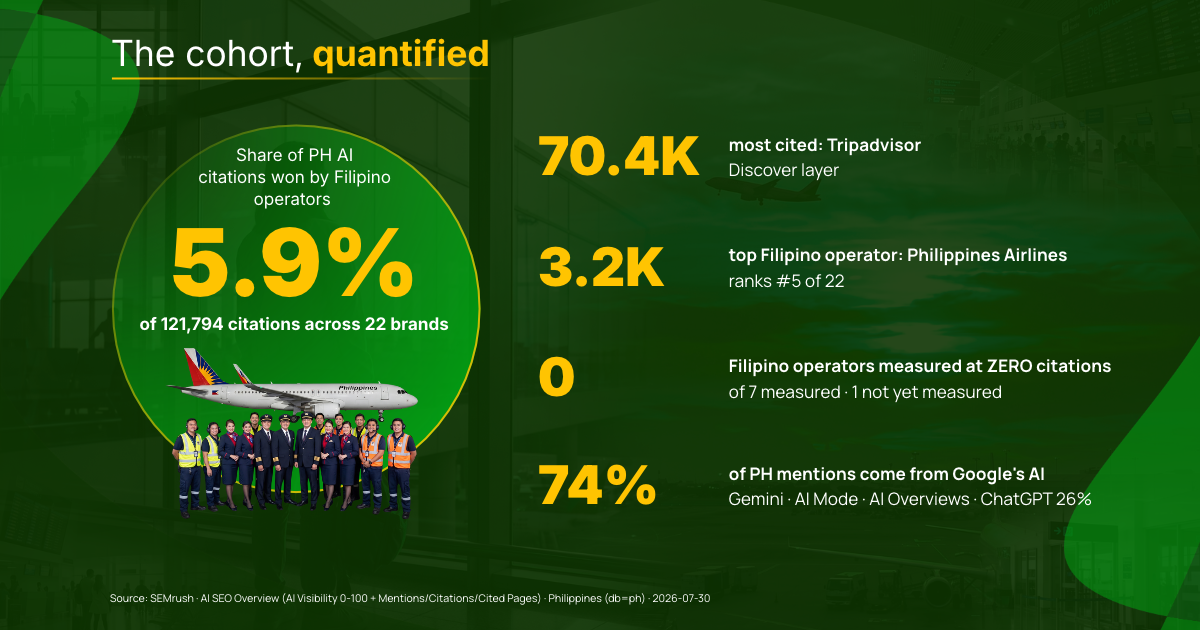
According to the 2026 Philippines Hospitality & Travel AI-Visibility Benchmark by Hashmeta AI, local travel and hospitality brands in the Philippines only cover 5.9% of the total AI citations in their own market. In the evolving landscape of generative AI search hospitality in the Philippines, the remaining 88% is going directly into the hands of global Online Travel Agencies (OTAs), review platforms, and international aggregators.
Analyzing the shift toward online travel agencies vs. direct hotel bookings, local operators are losing their spot at the AI answer layer. To drive more direct travel bookings locally, operators need to shift focus toward AI search engine optimization hospitality strategies to capture high-intent travelers.
So how does Philippine travel brands’ AI search performance stack up, and what can the industry do to build true Philippine hospitality AI visibility?
Five Key Findings from Hashmeta AI’s GEO report
Based on the latest benchmark data, here are the five core realities shaping AI visibility for Philippine travel and hospitality right now:
1. The Answer Layer Wins
Filipino operators absorb just 5.9% of local AI citations, while third-party aggregators, OTAs, and global review platforms capture the remaining 88.1% share of Philippine tourism data.
2. Google’s AI Is the Front Door
A dominant 74% of Philippine brand mentions originate across Google’s surfaces—Gemini (37.8%), AI Mode (28.1%), and AI Overviews (8.4%). Among AI tools, ChatGPT accounts for 26%.
3. Reach ≠ Recommendation
Traditional SEO authority still scores. However, high organic search traffic metrics no longer ensure inclusion in generative AI search answers.
4. Operators Score Zero
Local Filipino operators have earned zero citations. The good news is there is an actual baseline visibility to build on rather than a complete absence. Someone has already scratched the surface, so the industry does not need to dig deep. Companies just need to make sure they get a share.
5. The Category Is Unclaimed
The Philippines’ flagship airline, Philippine Airlines, leads the local field yet with only 3,200 citations. What does this mean for your business? It means no single travel brand currently owns the Philippine AI answer layer… yet
The Big Picture: Where Travel Citations Are Going
When we zoom in on the 121,794 total citations analyzed across 22 major travel brands in the Philippines, a clear pattern emerges:
- Tripadvisor is the undisputed king of discovery: Capturing 70.4K citations, Tripadvisor completely dominates the discovery layer. When travelers ask for recommendations, AI looks to review aggregators first, not direct resort or tour websites.
- Philippine Airlines leads local operators, but there’s a catch: PAL is the top-performing Filipino operator with 3.2K citations, yet it only ranks #5 out of 22 brands overall. Even the country’s flag carrier is out-ranked by global third-party platforms.
Measuring Philippine Hospitality AI Visibility: How Local Travel Brands Rank
Looking strictly at local Filipino operators in this cohort, airlines currently hold the lion’s share of visibility, while hotel chains and resorts struggle to hit double-digit citations.
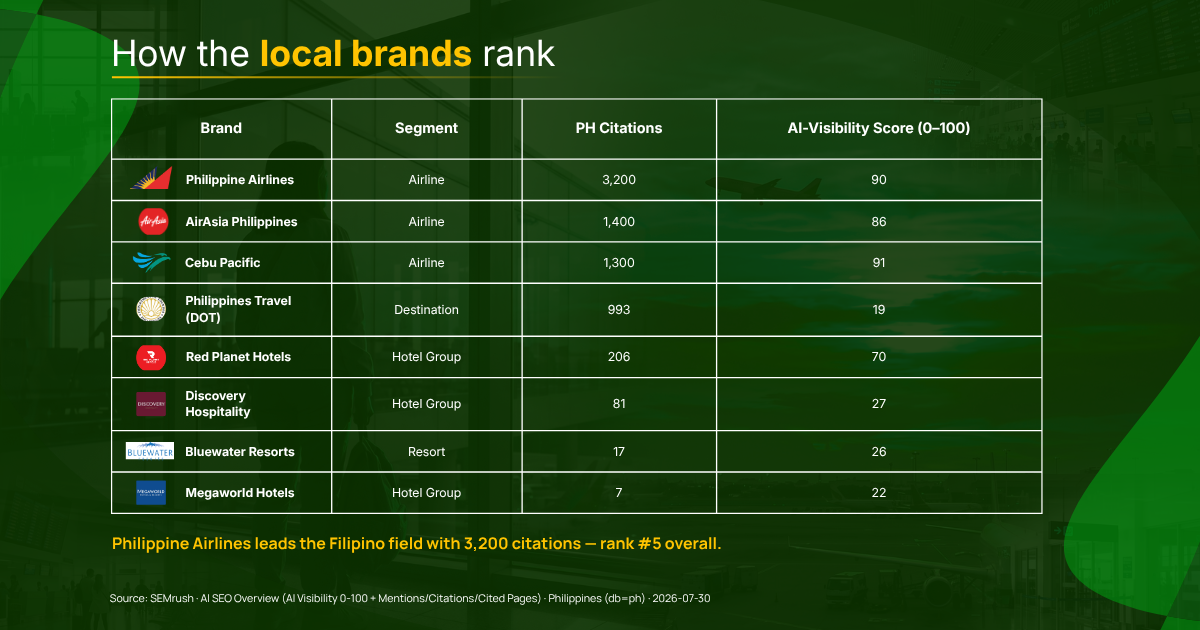
These metrics reveal a significant gap in overall Philippine hospitality AI visibility, particularly among luxury resorts and regional hotel chains.
While mega-resort chains rely on massive ad budgets, an agile boutique hotel marketing strategy leverages structured content and local entity signals to outsmart global Online Travel Agencies (OTAs) in generative search.
Key Takeaways from the Local Field:
- Airlines do the heavy lifting: PAL, AirAsia PH, and Cebu Pacific account for nearly all local operator citations because flight schedules and route queries provide structured data that AI models easily digest.
- Hotels & Resorts are nearly invisible: Major hotel groups and boutique resorts like Discovery Hospitality (81 citations), Bluewater Resorts (17), and Megaworld Hotels (7) are missing from generative answers. Travelers asking AI for hotel recommendations are almost exclusively receiving links to third-party OTAs.
Despite high brand awareness and premium offerings, luxury resort campaigns in the Philippines executing without structured schema leave local island properties hidden behind global review aggregators like Tripadvisor.
Being “Talked About” Isn’t the Same as Getting the Booking
Here is where travel marketers get tripped up: Mentions ≠ Citations.
- A Mention: The AI chat mentions your boutique hotel in passing while answering a general travel itinerary query.
- A Citation: The AI explicitly links your booking engine or website page as the authoritative source for rates, availability, and policies.
Take Booking Holdings, for example. They maintain a huge mention-to-citation ratio—being mentioned 24.3 times for every single citation earned—because AI treats them as a general conversation topic rather than the direct primary source. Meanwhile, local operators like Cebu Pacific turn 10,200 mentions into 1,300 citations (a healthy 7.8x ratio) by providing direct, actionable flight answers.
If your travel website features only dreamy, poetically written splash pages without clear, structured data, AI engines will talk about your destination—but send the actual booking link to Tripadvisor or Agoda.
The traditional SEO playbook is no longer enough. Your business should adopt hospitality generative engine optimization and ensure that your services, packages and promotions are properly indexed by conversational models like Google Gemini and ChatGPT.
The Playbook: Hashmeta AI’s CITE Framework for Travel Brands
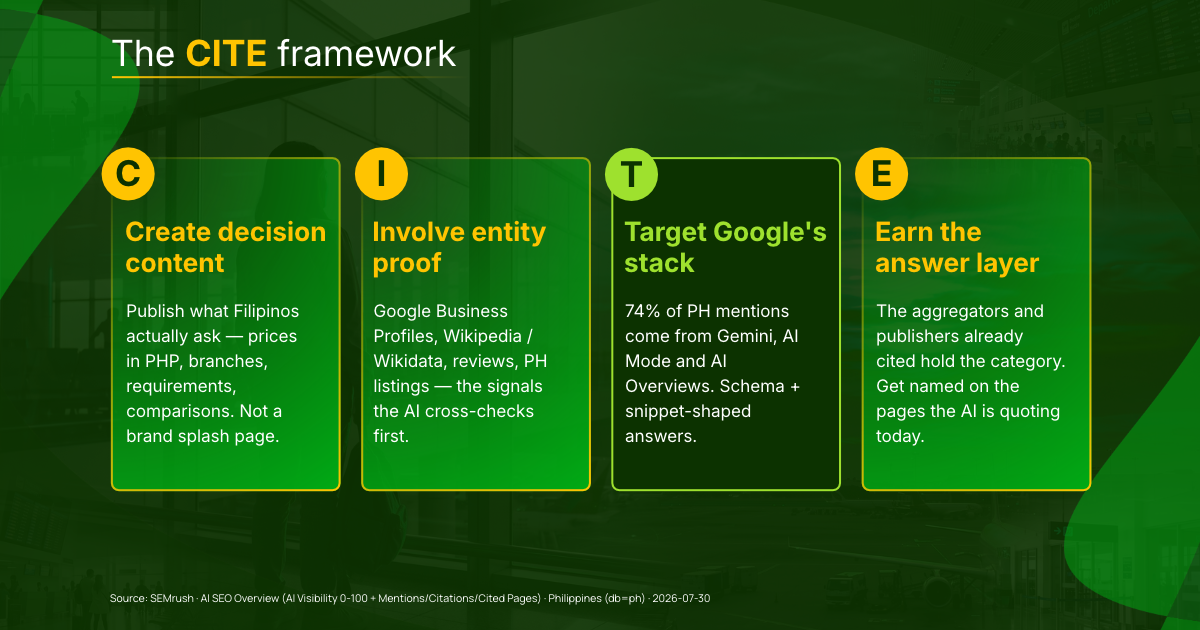
Travel brands need to stop losing commission-free direct bookings to third-party platforms and build strong Philippine hospitality AI visibility by transitioning to Generative Engine Optimization (GEO) using the CITE Framework:
Protect profit margins from third-party commission fees. Execute a data-driven agency or hotel direct booking strategy and optimize your answer layer visibility so AI search engines point guests straight to your reservation engine.
1. C – Create Decision Content
Travelers don’t search in abstract terms; they ask specific questions. Replace vague marketing copy with structured answers:
- Exact room rates and package pricing in Philippine Pesos (PHP).
- Clear airport transfer options, ferry schedules, and exact property locations.
- Inclusions, child policies, day-tour rates, and seasonal package details.
2. I – Involve Entity Proof
AI engines verify your resort or tour agency across multiple web sources. Ensure your Google Business Profile, Wikidata/Wikipedia entries, Tripadvisor listings, and local tourism board directories have matching NAP (Name, Address, Phone) details and updated operating hours.
3. T – Target Google’s Ecosystem
Since 74% of local search queries route through Google surfaces, optimize heavily for Google’s stack. Implement detailed Hotel / LocalBusiness schema markup and structure your content so Google Gemini and AI Overviews can extract direct answers effortlessly. You do not have to navigate this digital transformation alone— partnering with ZBiz Solutions gives you a dedicated strategic intelligence team to build the technical pipeline, track data, and manage your search and AI visibility to get your business ahead effortlessly.
4. E – Earn the Answer Layer
Because AI models rely heavily on top-10 listicles and review platforms, don’t just fight aggregators—partner with them. Get your property or experience featured in the “Best Resorts in Bohol” or “Top Island Hopping Tours” guides that AI tools are already reading.
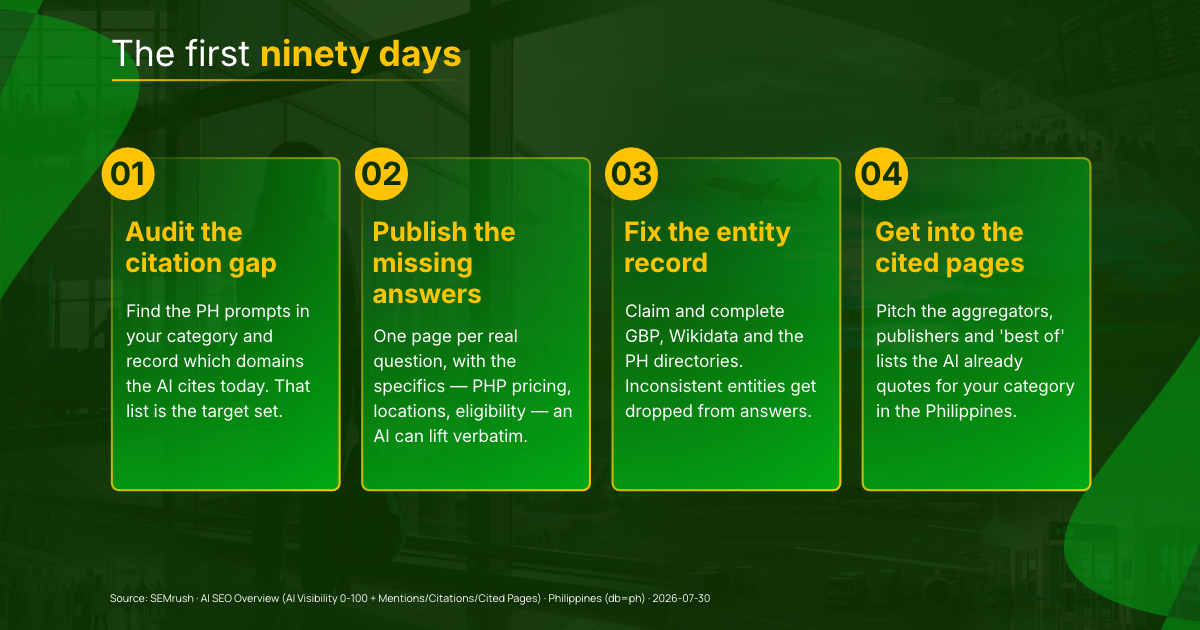
Where to Start? Here’s Your 90-Day Travel AI Roadmap
Ready to claim your share of the answer layer? Here’s your step-by-step quarterly plan:
Ready to check in to the future of travel search?
Don’t let third-party booking channels and OTAs own your brand’s AI search presence. Partner with ZBiz Solutions to audit your citation gap, optimize your technical presence, and turn AI search queries into direct guest reservations today.